Showing posts with label vintage jewelry. Show all posts

Tuesday, September 15, 2009

what is celluloid jewerly?


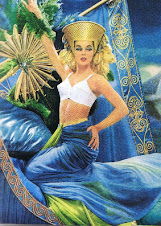
I have always favored vintage plastic jewerly and have been intriged with bakelite and others but celluloid is truly capitaving. Many times it is carved as showen in the above photo. This is one way of idnetifing this chariming plastic.


Webster's Revised Unabridged Dictionary (1913) Tells us that Celluloid (n.) is
a " substance composed essentially of gun cotton and camphor, and when pure resembling ivory in texture and color, but variously colored to imitate coral, tortoise shell, amber, malachite, etc. It is used in the manufacture of jewelry and many small articles, as combs, brushes, collars, and cuffs; -- originally called xylonite."

I learned that celluloid was one of the first plastics used for jewelry. This is a PLANT FIBER ! A natural product that was developed in the 1850s in England.

Later, John Wesley Hyatt commercialized the use of celluloid. The use of this material in vintage jewelry is quite old dating to about 1900.

Popular as a material during the Art Deco period which is from 1920-1935, it was made into all kinds of useful things , such as hair combs and clips.

Highly carved designs were often found on celluloid jewelry pieces, ( as the above photo shows) and flowers and leaves were commonly seen.

"One of the biggest uses of celluloid in vintage jewelry was to make brooches and dress clips, especially during the early 20th century. Celluloid looks similar to some other vintage plastics, but it differs in many ways. It is generally much thinner and lighter than bakelite. It is also much more brittle and can crack when exposed to high heat temperatures - sometimes even being flammable. Even though it can be brittle, it can still be twisted or bent into shape quite easily.

To test a piece of jewelry to see if it is celluloid, hold the item under hot water. it will smell like camphor or vinegar. Never use a hot pin test on celluloid because of the flammability factor." (Today's Vintage Jewelry Word - Celluloid )

Saturday, June 27, 2009

What is a jelly belly pin?


jfbc785t2q


This example of a jelly belly with carved Lucite is selling for $425.00 on www.trifari.com/ . I did some limited research and they are very expensive.

Many collectors, including myself, love the jelly belly pin. They are generally figural pins such as fish, birds, turtles, swans and other creatures. Each animal has a clear acrylic stone inset in his belly or center of his body. They were first created by Trifari in the 1940's and copied by Coro. View our slide show of pins and you will see an example of a traditional jelly belly pin that we have for sale at

http://www.etsy.com/view_listing.php?listing_id=27061806

Was Sterling Silver ever used in costume jewelry? Can the markings help me date it?What is Vermeil?


This butterfly is an example of vermeil.

During World War II many jewelers began to use sterling sliver, Why? because the other metals that were previously used, were needed for war materials...bullets etc. The United States , in 1906 passed, the National Stamping Act. This act requires that all silver be marked. Any product that was marked as silver, needed to contain 925 per 1,000 parts of pure silver.

After 1961, the act was amended. It required the manufacturers of sterling to also stamp the maker's mark on the piece.

Therefore one can date these marked pieces. Jewelry made between 1906 and 1961 may only be marked 925 or sterling.

While jewelry made after 1961, should have the manufacturers mark as well. Yet, it is known that many did not follow the law. So it becomes a bit trickier.

Sterling may and often does have a gold wash over them. This process is called vermeil It was used to give a piece the look of gold. unfortunately it wears away over time.

Some pieces, even with some wear of vermeil, are still worth collecting, depending on the designer,the rarity and how collectible the piece is, what designer it is, how many were made, etc...

What type of clasps do vintage pins have? How can they be used for dating?


The locking C-clap was patented in 1901 . In 1910 it began to be used allot. What makes it distinctive is the spinning locking mechanism. This spinning lock makes it secure and prevents it from dislodging. This was one of the most popular clasp which is even sometimes today.

Then there is the plain c-clasp which is similar but it does not have the spinning mechanism.

The tube clasp was patented in 1850 and was used until after World War II. Europeans favored this clasp. The knob pulls out to release the long pin. This type of clasp is very useful in dating your pin.Pins with type of clasp are from the period of 1850 to 1910. Do not pass up these gems, they are old and collectible.

Another point of interest is to note the pin stem that sometimes is found to extend beyond the c-clasp . An extra long pin stem is sometimes an indicator of a piece of jewelry that is older.

Also older pins are many times molded in two or more pieces, then these pieces are held together with a rivet.

What is a Rhodium finish?


The picture shows an example of a necklace set with rhinestones and a superior example of the beauty and luster of the rhodium finish. Rhodium is a quality metal and highly collectible. It is part of the platinum group!


Most custom jewelry is made from a white metal that is a combination of other metals which can include tin,lead, and cadmium. When the piece is white metal then the process is called electroplating. This process covers the dull metal with a thin layer of another metal.


"Rhodium is a metal that is part of the platinum group of metals and is often used to coat white metal" Rhodium, a hard metal was used because the plating did and does not chip away. In addition, Rhodium is highly reflective which makes it distinctive and beautiful. It holds its luster. There is not a look of tarnish ever or the appearing of a 'pot metal' look.

Rhodium tends to be more collectible because it holds so well up to the rigors of time. Pieces are in good condition and this finish was used on quality pieces.

Most rhodium finished pieces were produced after World War II which helps in dating your piece.

AVOID METALS THAT ARE TURNING GREEN. It is a "mold-like patina", it indicates that the metal is starting to break down. It is a type of rust and metal is already damaged! It renders the piece worthless. We recommend a purchase only if you tend to remove the beads for reuse.


Source:Collecting Costume jewelry 101 by Julia Carroll

Pretty pins!